
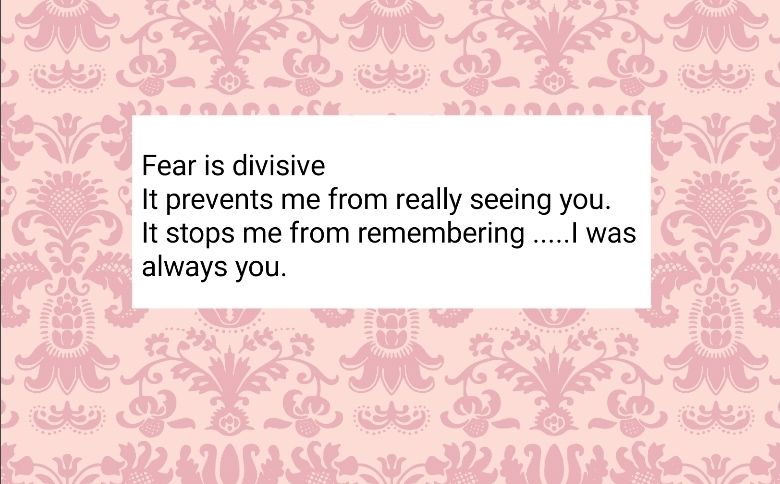
Our wounds originate from the places within us, where light has not yet permeated.
Today, I’m becoming increasingly aware of how my triggers arise from experiences I have not yet consciously processed. Places where the light of consciousness and attention has not yet shone upon the trauma, the hurt, the fear, hidden in the deeper spaces of my body as memory.
Yesterday, Colin said something quite profound. He had read somewhere that the opposite of grief is not joy, or even contentment. It is forgetting. Not remembering.
When you forget a past hurt or a loss , you no longer grieve it.
That got me thinking.
There are different levels of forgetting, aren’t there?
Sometimes we forget because something has genuinely lost its emotional charge. We can remember the experience without reliving the pain. But at other times, we forget only at the conscious level. The mind may have pushed something away, but the nervous system continues to respond to reminders of what once put us into fear or hurt us.
The body remembers what the mind strives to forget.
And the mind, rather unfortunately, also has a tendency to hold on to the very things that trouble it. To revisit old hurts, to anticipate threats, to protect itself from something that may no longer even be happening.
So perhaps the opposite of grief isn’t really forgetting.
Perhaps it is integration.
To remember without suffering in the same way. To acknowledge what happened without continuing to live inside it. To allow the memory to remain, but without the same emotional charge attached to it.
So how does one proceed?
Perhaps by first accepting that there are parts of us that are yet unhealed. Parts that will, from time to time, rear their heads, asking for our attention.
Not because something is wrong with us, but because there is something within us that is asking to be seen.
By becoming more conversant with our bodies. By deliberately and gently bringing the light of awareness to the places that have remained hidden. Diligently, consistently, but without turning healing into yet another task that needs to be accomplished.
And perhaps, sometimes, without even needing to understand or analyse what is happening. Simply allowing ourselves to feel what we feel, without judgment or resistance.
I’m also beginning to understand compassion at a deeper level.
In the recent past, I’ve noticed that many of the situations in which I’ve felt the need to dig my heels in, to defend my position or stand my ground, have come from my own triggers.
And when I’m interacting with others and their triggers show up, I can now see that their reactions, too, may come from wounds that have remained hidden. Hurts and fears they may have carried for far longer than they consciously realise.
Perhaps, like me, they have forgotten these wounds within themselves.
And then I wonder…
Is it really me clashing against them?
Or is it our wounds that are clashing? Our unresolved emotions, our fears, our old hurts, each trying in its own way to protect us from being hurt again?
That realisation, brings with it a completely different perspective to the interactions.
Instead of seeing someone as difficult, unreasonable or deliberately hurtful, I can begin to recognise the possibility of pain behind their behaviour.
Of course, this doesn’t mean that hurtful behaviour becomes acceptable, or that compassion requires me to abandon my own boundaries/ understanding.
I can understand someone without agreeing with them. I can have compassion for their wounds without allowing those wounds to deepen mine.
Also, equally importantly, I don’t need to rush past my own hurt in order to understand theirs.
My feelings deserve the same tenderness and compassion that I am learning to extend to others.
So instead of reacting from my wounds, or allowing someone else’s wounds to further deepen mine, I choose to turn inward. To look at what I am carrying. Not to judge it, suppress it or even rush to heal it, but simply to meet it with love, awareness and compassion.
Perhaps healing isn’t about fixing all the broken or wounded parts of ourselves.
Perhaps it is about realising that even these parts are worthy of our love.
And perhaps this is what bringing light into the darkness really means. Not trying to eliminate the darkness, but allowing it to exist within the same loving awareness as the light.
The more I recognise my own vulnerability, the easier it becomes to recognise it in another.
And somewhere in that recognition, the need to defend, to judge, to be right, begins to soften.
There is just me, and there is you.
Two human beings, each carrying experiences, memories, fears and hurts. Each doing the best we can with the awareness available to us in that moment.
And perhaps compassion is simply remembering that.
That beneath all our reactions, our defences and our differences, there is a shared humanity.
And that the light of awareness need not choose whose wounds are worthy of being held.
It can hold us both.
Simi ❤️

